
We recently surveryed professionals across the UAE to better understand how the current market is impacting hiring, job searching, and workplace confidence.
Our findings closely mirror wider regional data recently published by GulfTalent, which showed Gulf jobseeker activity dropped sharply following the regional conflict before beginning a gradual recovery.
GulfTalent reported a 35% drop in professionals registering on the platform, alongside a 24% decline in companies posting jobs during March 2026. Activity has since started to steadily improve following the ceasefire.
Combined with our own survey responses and daily conversations across the UAE market, a clear picture is emerging: hiring has not stopped, but confidence, timing and decision-making have shifted.
Hesitation at Decision Stage
One of the clearest themes from our survey was hesitation during the final stages of hiring.
Roles are still being approved and recruitment is still happening, but timelines are stretching. We are seeing more internal discussions, more stakeholders involved in hiring decisions, and greater scrutiny around new headcount.
Businesses are being more cautious around timing, budgets and long-term planning - not because the need for talent has disappeared, but because companies are taking a more measured approach.
The challenge is that candidates do not slow down in the same way businesses do. When hiring processes lose momentum, companies risk losing strong talent to faster-moving competitors. We have seen this ourselves over the past month, where clients reached offer stage only to discover their preferred candidate had already accepted another opportunity.
In this market, structure, communication, and decisiveness matter more than ever.
More local strong talent is available
Another clear trend from our survey was the growing number of experienced professionals now open to opportunities.
Some respondents had been directly impacted by redundancies, reduced business activity, or uncertainty within their sector. Others were reassessing longer-term stability and career direction.
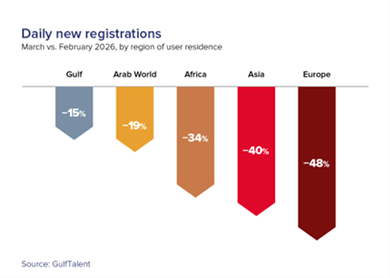
While job boards and our internal database are showing a decline in “fresh” overseas talent entering the UAE market, GulfTalent reported a 48% drop in search activity from Europe. At the same time, experienced UAE-based professionals who may previously have been unavailable are now becoming more visible in the market.
For employers, this has created a rare window where high-qulaity local talent is more accessible than it has been in recent years.
One noticeable shift has been the reduction in “noise” across the market compared to previous years. During the height of the post-Covid boom, many roles were flooded with applications from overseas professionals looking to relocate quickly to the UAE, creating intense competition and often overwhelming hiring processes.
That volume appears to have eased, at least for now.
While competition for strong roles absolutely still exists, we are seeing fewer speculative applications from new market entrants and a greater proportion of candidates already based in the region, with local experience and a longer-term commitment to their careers here.
For employers, this presents a genuine opportunity to access strong talent in a less congested market than we have seen in recent years.
And for candidates, this is a market that rewards patience, positioning, and strategic career decisions rather than reactive moves.
Candidates are becoming more selective
One of the more interesting findings from the survey was that employed professionals are not rushing into change. Instead, they are evaluating opportunities more carefully, and they are not all looking to leave the region.
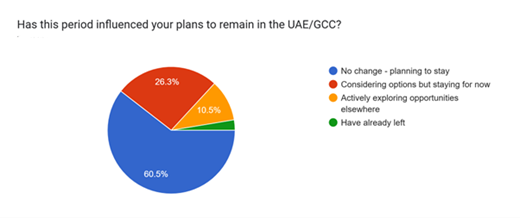
Stability, leadership, flexibility, culture, and long-term prospects are now playing a bigger role in decision-making than they did previously.
We are also seeing candidates place greater importance on transparency throughout the hiring process, particularly around company direction, expectations, and working style.
Strong locally based candidates are available, but attracting them increasingly requires businesses to clearly position both the opportunity and the long-term vision behind it.
Flexible Working Remains an Important Topic
Another trend emerging from our survey is a gradual shift back towards more structured office-based working in some organisations. Since the ceasefire, many companies have actively encouraged employees to return to the office.
Eighty-six percent of employed respondents reported they are now working from their usual location within the UAE, with only 4% still working remotely or outside the country. However, 20% did report that companies had adopted more flexible arrangements during the conflict period.
There remains a growing mismatch between employer and candidate expectations around flexible and hybrid working. In many hiring conversations, clarity around working style is now becoming just as important as salary.
Market Recalibration
Overall, outside of sectors such as hospitality, the findings point towards a market that is recalibrating rather than declining.
Hiring continues. Businesses are still investing. Candidates are still exploring opportunities.
At Inspire Selection, we will continue sharing insight from both sides of the market as the landscape evolves.


